Procurement infrastructure and capital planning for institutional real estate portfolios.
One governed workflow across every asset in the portfolio — feeding approved outputs into existing systems of record.
From property context to vendor award.
One workflow for every project — grounded in the asset's record and governed by portfolio standards.
Start with the asset
Every scope begins with the property itself — its attributes, its history, and the specific work intended. No blank templates.
Start with the asset
Every scope begins with the property itself — its attributes, its history, and the specific work intended. No blank templates.
Draft the scope
A first draft is generated from approved scope standards, prior work on the asset, and portfolio approval rules — ready for internal review.
Draft the scope
A first draft is generated from approved scope standards, prior work on the asset, and portfolio approval rules — ready for internal review.
Catch gaps before release
Pre-release review flags missing attachments, approval steps, and scope requirements so the team resolves them before the document leaves the platform — not after bids come in.
Catch gaps before release
Pre-release review flags missing attachments, approval steps, and scope requirements so the team resolves them before the document leaves the platform — not after bids come in.
Issue to vendors
Vendors receive the current package through governed access — with version clarity and controlled distribution in place of email chains.
Issue to vendors
Vendors receive the current package through governed access — with version clarity and controlled distribution in place of email chains.
Compare bids, hand off the award
Vendor responses return to the same workflow. A consolidated bid tabulation supports the award decision and hands off cleanly to the systems that execute the contract.
Compare bids, hand off the award
Vendor responses return to the same workflow. A consolidated bid tabulation supports the award decision and hands off cleanly to the systems that execute the contract.
Multi-year plans that roll directly into live projects.
Portfolio capital plans are drafted, revised, and carried forward inside the platform — rooted in each asset's record, not in a spreadsheet that drifts out of sync.
- Draft, approve, and revise multi-year plans by asset and portfolio
- Revisions tracked in place — no version sprawl across files
- Planned items promote into scoped projects without re-entry
Plain-language queries, answered from the portfolio's own record.
Results stay confined to the selected property and project. Answers come from the asset's structured record — scopes, awarded values, outcomes, and timelines.
- Queries are dual-scoped — property and project.
- Responses return as structured rows grouped by project status.
- Answers are drawn from stored portfolio records, not open-web content.
Purpose-built tools where the scope gets written.
Markup, measurement, and field capture live inside the platform — integrated with the asset record rather than routed through external tools.
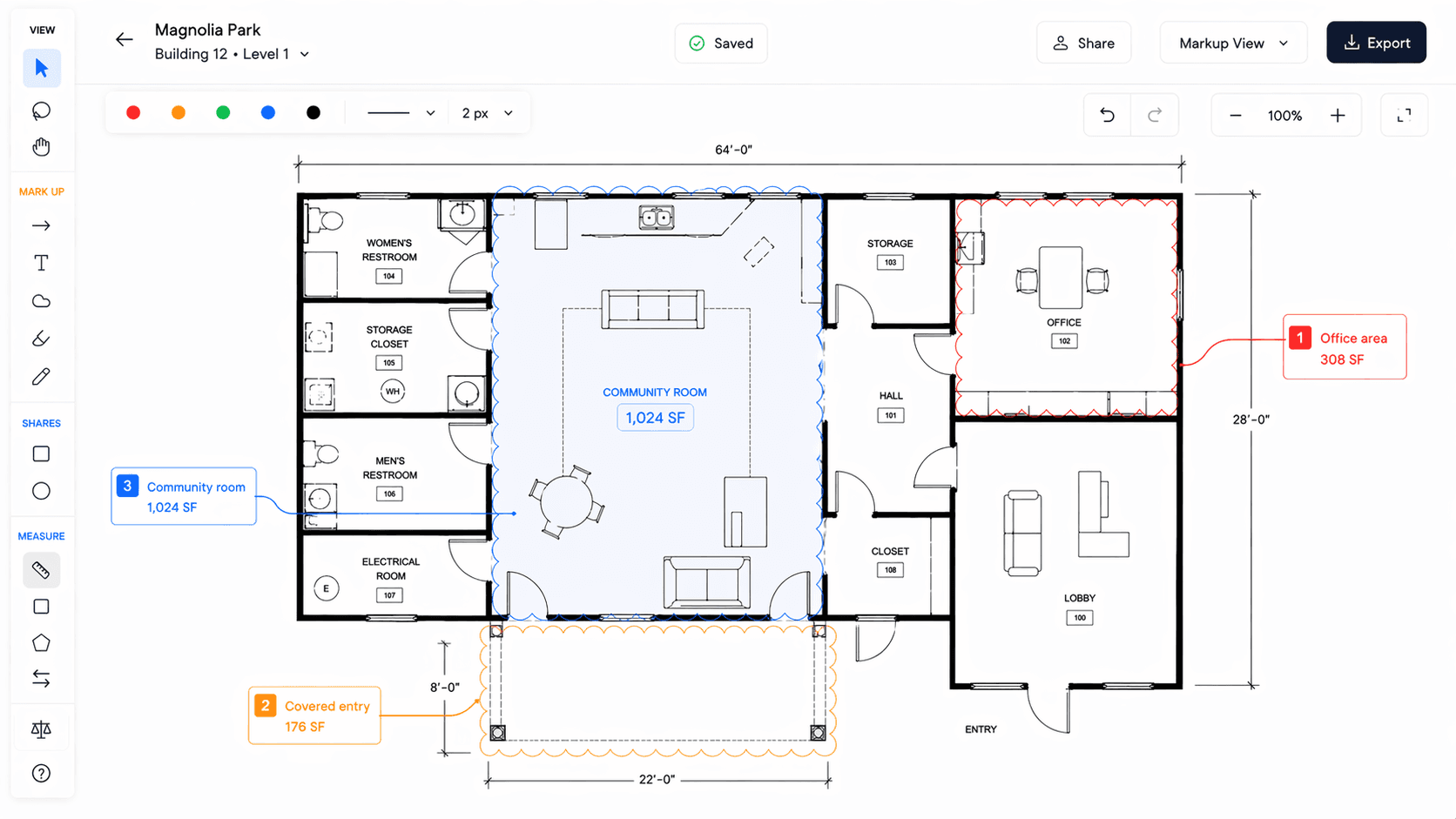
Markup Studio
Plans and drawings open in a shared workspace where scope is defined visually and measured once. Markups and takeoffs attach directly to the procurement package.
Define scope visually
Highlight areas, cloud conditions, and annotate directly on plans.
Takeoffs in place
Measured areas and quantities captured once and carried through the package.
Attach to the package
Marked-up plans embed alongside the scope of work, bill of quantities, and request for proposals.
Tied to the asset
Markups and quantities persist with the asset record for lookback.
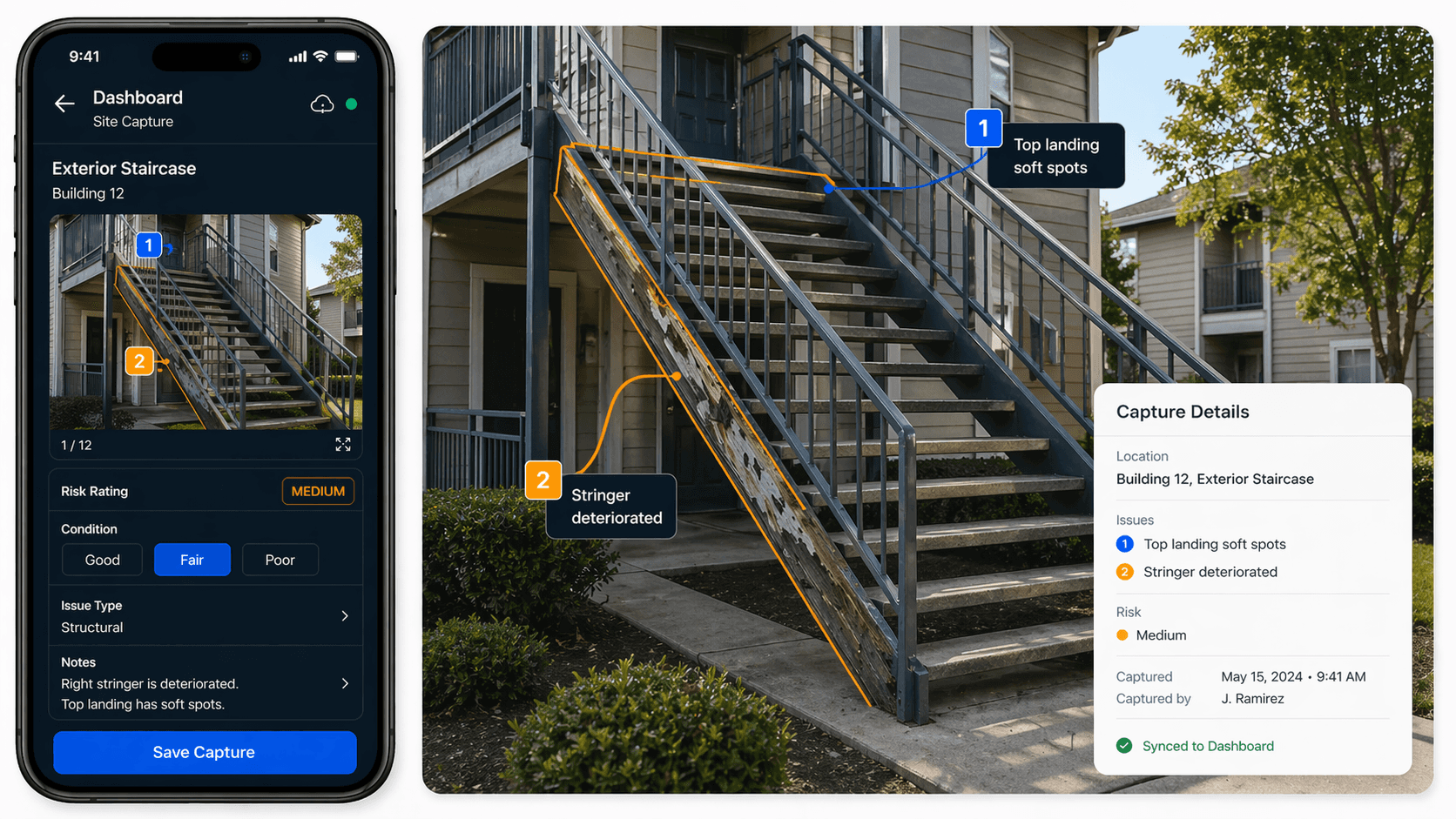
SiteOptix™ Field App
Mobile field app for site captures, inspections, and risk reporting. Records sync back to the platform and feed the asset's structured record.
Capture in the field
Photos, notes, measurements, and locations in one place.
Assess and flag risk
Tag conditions, assign risk levels, and add recommended actions.
Sync to the platform
Records sync securely and update the asset's structured record.
Traceable and searchable
Every capture is time-stamped, linked to the asset, and easy to find.
What changes at the portfolio level.
Three operating shifts when planning, scoping, and procurement run through one governed layer.
Institutional memory outlasts turnover.
Project history lives with the asset, not the individual managing it. Turnover stops resetting institutional knowledge.
One rulebook, every property.
Scope standards, approval rules, and risk classifications are governed once at the portfolio level. Every property draws from that layer — new assets inherit it automatically.
Existing systems stay in place.
The platform sits upstream of contract, accounting, and property systems already in use — feeding clean, structured inputs into what's already running.
Every document request passes through one enforcement layer.
External access is token-verified, role-scoped, version-pinned, and recorded — governed at the gateway, not at the inbox.
1Tokenized Access
Tokenized Access
Every request is token-verified at the gateway. Forwarded links and direct URLs do not resolve outside their scope.
2Role- and Project-Scoped Delivery
Role- and Project-Scoped Delivery
Recipients see only packages tied to their active role and project. Scope changes end access immediately.
3Version-Pinned Retrieval
Version-Pinned Retrieval
Retrieved documents are always the current approved version. Superseded packages stop resolving.
4Full Access Audit Trail
Full Access Audit Trail
Every allow, deny, and override is recorded against user, scope, and package — reviewable by project or across the portfolio.