Controlled Procurement Package Generation for Portfolio Teams
Procurement infrastructure and capital planning for institutional real estate portfolios
Asset-aware, deterministic, governed document automation for upstream procurement
Overview
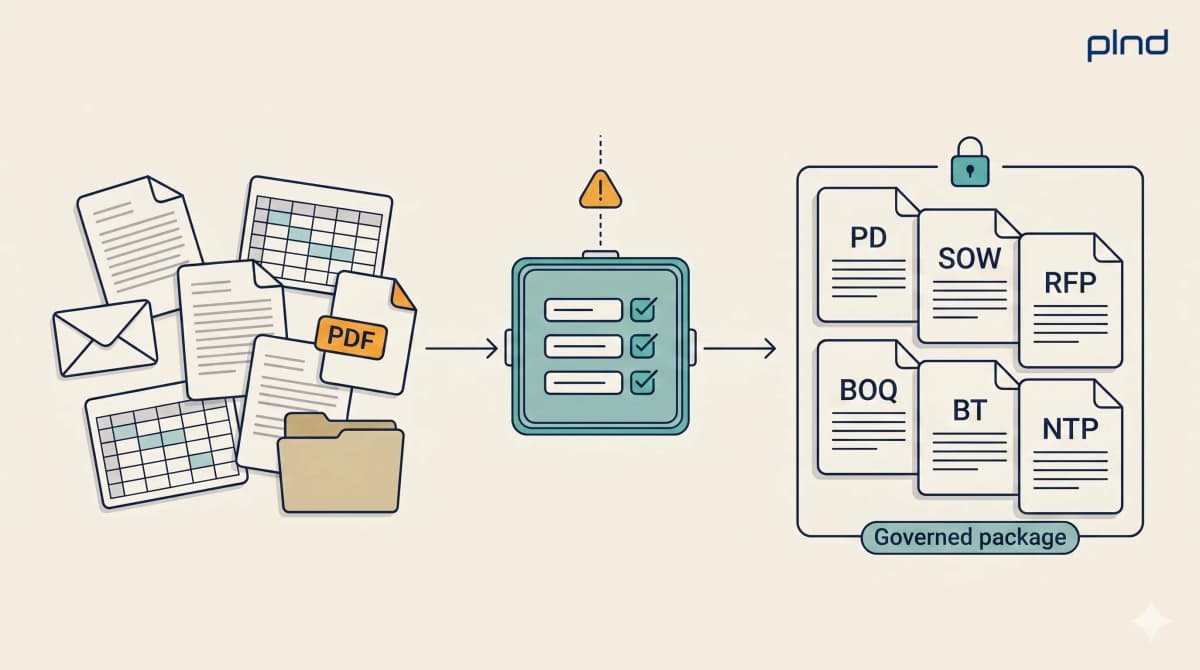
Construction and real estate organizations produce large volumes of vendor-facing documentation that directly impacts cost, risk, schedule, and outcomes. Yet many teams still create Scopes of Work (SOW), Requests for Proposal (RFP), and Bills of Quantities (BOQ) through manual drafting, template reuse, and fragmented distribution.
This operating model creates recurring enterprise failure modes: scope drift, stale packages, liability exposure, and trapped intelligence (pricing, vendor performance, and timelines locked in files and spreadsheets).
The platform standardizes and accelerates upstream procurement for portfolio teams by producing controlled, consistent procurement packages and distributing them through governed access, supporting traceability and audit readiness at scale.
The platform is not "freeform AI writing contracts." Structured assistance is applied within controlled workflows so teams move faster without losing oversight.
The documentation challenge
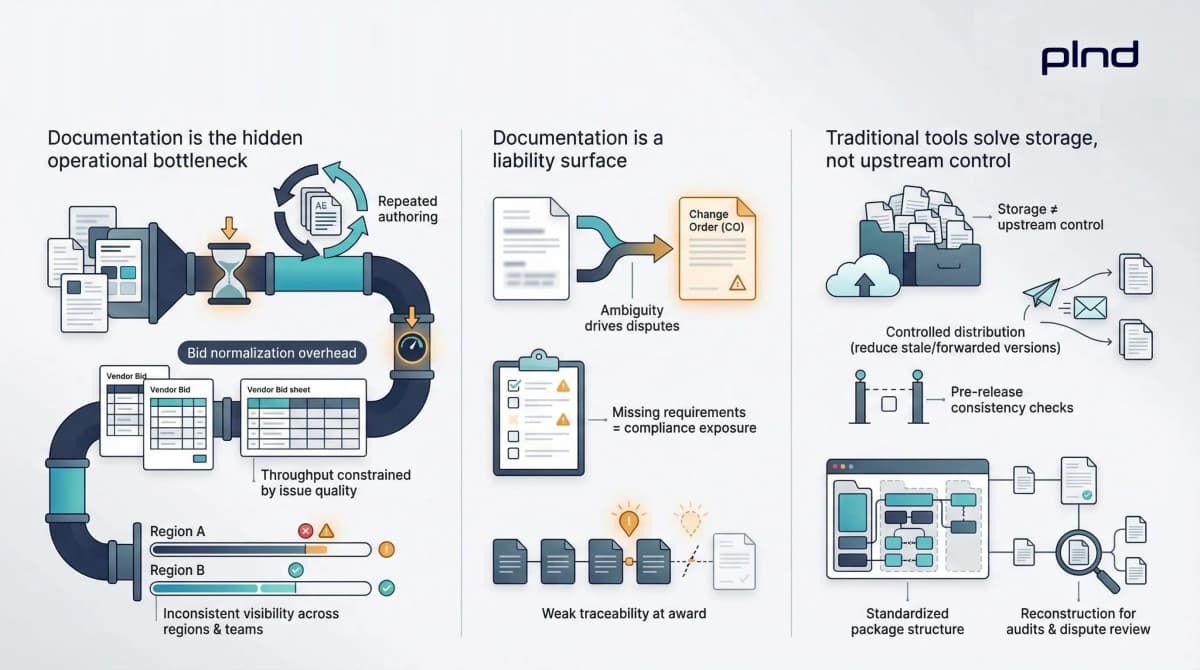
Documentation is the hidden operational bottleneck
In portfolio environments, procurement throughput is often constrained by the quality and consistency of what gets issued to vendors. Common symptoms include repeated authoring, bid normalization overhead, and inconsistent visibility across regions and teams.
Documentation is a liability surface
Many costly outcomes trace back to upstream document quality and governance: ambiguity drives disputes and change orders, missing requirements create safety/compliance exposure, and weak traceability makes it difficult to prove what was issued and agreed at the time of award.
Traditional tools solve storage, not upstream control
Repositories and coordination tools store files, but upstream procurement often needs standardized package structure, pre-release consistency checks, controlled distribution to reduce stale/forwarded versions, and post-hoc review support for audits and dispute review.
What plnd does
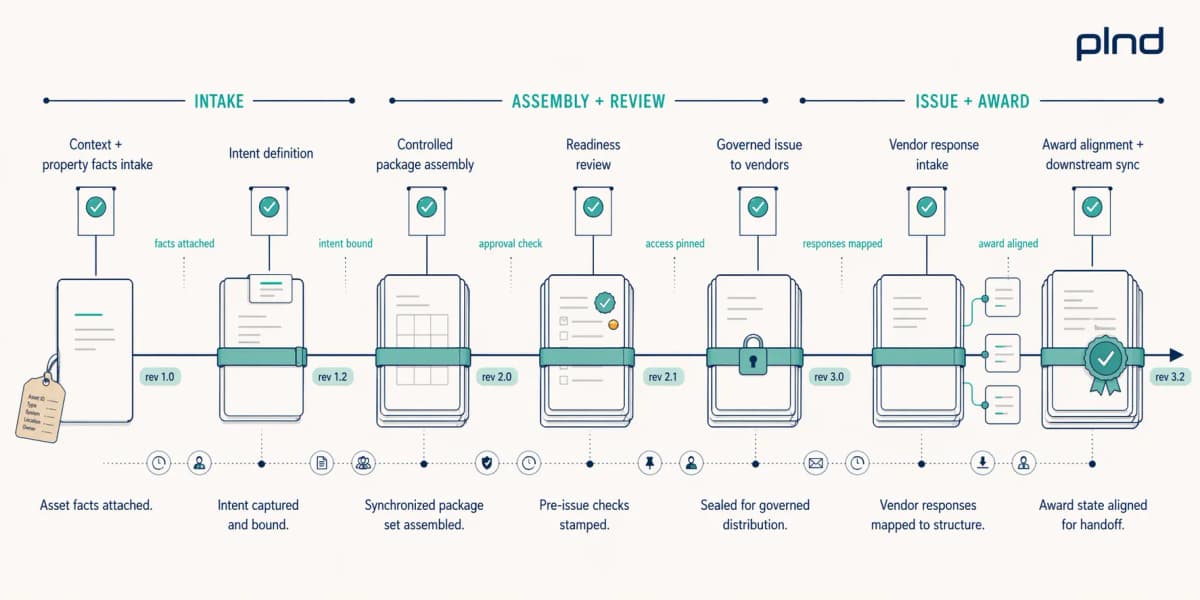
The platform converts procurement context and intent into a procurement package through a controlled workflow:
Context + Intent → Controlled Assembly → Readiness Checks → Governed Distribution → Award Alignment
The platform produces and maintains synchronized procurement artifacts such as:
- Project Descriptions (PD)
- Scopes of Work (SOW)
- Requests for Proposal (RFP)
- Bills of Quantities (BOQ)
- Bid Tabulations (BT)
- Notices to Proceed (NTP)
Deterministic generation (plain-English)
When the same approved inputs and rules apply, the system produces the same package state, supporting consistency, reviewability, and post-hoc review.
Platform architecture
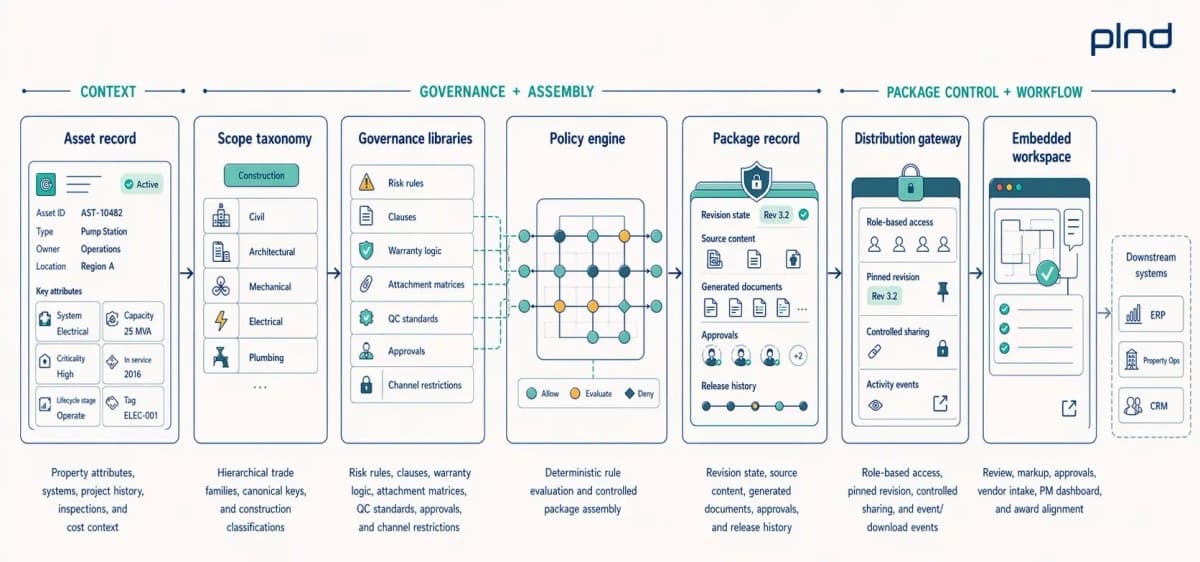
The platform is structured as a governed document pipeline rather than a generative authoring tool. Each layer performs a specific role in converting asset context and procurement intent into a procurement package, with package state, rule application, and release history separated by layer.
Asset record
The foundation of the platform is a structured record of each property — attributes, systems, prior project history, inspection context, and cost history where available. All downstream work is derived from this record rather than from standalone templates. The asset record provides the primary context used to assemble each package and its related procurement documents.
Scope taxonomy
Scope types are organized into a proprietary, hierarchical taxonomy spanning the major construction trade families — building envelope, roofing, mechanical, electrical, plumbing, site, interior finishes, amenities, and others. Each scope type carries a canonical key and may be associated with industry-standard construction classification codes, including CSI MasterFormat, for alignment with architect specifications and accounting structures. The taxonomy is purpose-built for governed procurement; it is not a re-implementation of any external code system.
Governance library system
Procurement requirements — risk classifications, clause libraries, warranty rules, required-attachment matrices, testing and QC standards, approval thresholds, channel restrictions — are stored in a structured library system rather than baked into templates. Libraries are versioned, tenant-scoped, and applied at generation time through policy evaluation. This structure applies the same requirement set across packages without relying on template-by-template edits.
Policy engine
A deterministic policy engine evaluates each document request against tenant-scoped rules before package assembly. The engine decides which libraries apply, which requirements must be enforced, which reviewers are involved, and which distribution paths are available. For a given approved input set and ruleset, the engine supports repeatable package assembly and post-hoc review of the resulting package state.
Package record and revision history
Each procurement package exists as a governed record with explicit revision state, source context, and release history. Generated documents, approvals, and superseded revisions are associated with the package record rather than managed as disconnected files. This provides a stable object for review, comparison, distribution, and downstream handoff.
Distribution gateway
External access to released packages flows through a distribution gateway (Bid Inbox) rather than through raw file attachments. The gateway applies role-scoped access controls, serves a pinned package revision, and records gateway access events including views and downloads. When a gateway-served package is superseded or withdrawn, the accessible revision is updated at the gateway.
Embedded workspace
Package review, markup, and approval take place inside the project workspace, integrated directly with the asset record. Markup Studio supports visual scope definition and takeoff on drawings. SiteOptix™ Field App, a companion mobile module, provides structured on-site documentation that feeds the asset record and related package workflows.
Position in the enterprise stack
The platform is designed to sit upstream of accounting/ERP, property operations, and CRM systems commonly deployed by institutional real estate operators. Structured outputs — scopes, awarded values, project metadata — are produced for downstream export and system handoff rather than for system replacement. The platform governs the authoring and procurement workflow; downstream systems remain the system of record for contracts, payments, leases, and client relationships.
Core capabilities
- Standardized package generation
Generates consistent procurement packages using standardized content patterns and portfolio rules, reducing rework and variability across properties.
- Package alignment for clearer bidding
Keeps scope requirements and bid structures aligned so vendors respond in comparable formats and procurement evaluates bids with less manual normalization.
- Pre-release readiness checks
Flags omissions and gaps that commonly trigger requests for information, re-issuance, and late discovery of requirements.
- Governed distribution to reduce stale "final" packages
Distributes packages through governed access rather than uncontrolled attachments, supporting access checks at time of view and reducing reliance on forwarded files. When a package changes, the accessible revision can be updated to reduce confusion about what was actually issued.
- Optional visual context for bid clarity
Markup Studio supports optional annotated photos and exhibits to reduce ambiguity and back-and-forth during bidding.
- Optional site-condition capture
Optional structured capture of site conditions via the SiteOptix™ Field App (photos + basic location context) so packages start from current reality rather than template assumptions.
- Lookback (asset-aware decision support)
Surfaces relevant prior work at the asset level — past project scope, outcomes, timelines, bid history, and supporting context — so project managers can make better decisions without hunting through disconnected files across multiple platforms.
- Rolling capital planning support (from standardized records)
Because procurement records are standardized, teams can more easily roll forward planning inputs using consistent project data and historical package context, improving prioritization, forecasting discussions, and portfolio-wide visibility.
- Structured assistance grounded in tenant-approved sources (optional)
Where enabled, recommendations can be grounded in tenant-approved sources (standards, rules, prior packages, and captured site context) and presented as reviewable changes — supporting speed without "freestyle" edits.
End-to-end workflow
- Context + Property Facts Intake
The platform uses asset and project facts (property attributes, project metadata, constraints, historical work context where available) alongside project manager (PM) input to ground the package in the actual property and avoid "template drift."
- Intent Definition (controlled starting point)
The PM defines the outcome, scope boundaries, inclusions/exclusions, assumptions, schedule constraints, and bid intent—so every downstream document is derived from explicit intent, not ad hoc edits.
- Controlled Package Assembly (synchronized outputs)
The platform produces a synchronized package set (PD / SOW / RFP / BOQ) where scope requirements and bid structure stay aligned, supporting clearer bidding and easier evaluation.
- Readiness Review (pre-issue quality checks)
Before anything is issued, the system flags common gaps and inconsistencies that drive requests for information and re-issuance (missing requirements, misaligned bid rows, incomplete scope boundaries). Reviewers resolve issues prior to release.
- Governed Issue to Vendors (single source of truth)
Vendors receive permissioned link access to a single package source, reducing stale "final" attachments, uncontrolled forwarding, and confusion over what is current.
- Vendor Response Intake → PM Dashboard
Vendor proposals and completed bid breakdowns are submitted back through the governed workflow and land directly in the project manager's workspace, mapped to the issued package structure to support cleaner comparisons and faster leveling.
- Award Alignment + Downstream Sync
Award outputs (e.g., bid tabulation and NTP) reflect the issued package state to reduce disconnects between what was issued, priced, and awarded, supporting traceability and defensibility.
Governance and audit readiness
Governance in the platform is enforced at the policy engine rather than through process convention. The result is a defensible record of what was issued, under what rules, by whose approval, to whom, and when.
Policy enforcement
Required controls are applied by the policy engine at generation time, not assembled by convention at the authoring desk. Rule application is deterministic and tied to the library state recorded with the package at generation time.
Approval model and segregation of duties
Packages move through an approval chain with distinct author, approver, and releaser roles. Roles are separable, and authoring, approval, and release are enforced as distinct steps in the approval chain.
Exception handling
When a policy control is overridden, the platform captures the override rationale, the approver identity, and the timestamp, and retains them in the package record. Exceptions are recorded as first-class events rather than as informal notes.
Revision and supersession
Each package carries an explicit revision state. When a superseding revision is released, the prior revision is retained in the package record as historical state rather than replaced.
Release sealing. When a package revision is approved and released, the platform computes a cryptographic hash of the released artifact and stores it with the package record. Gateway access is pinned to that sealed revision, so the record shows exactly what was issued, to whom, and when.
Distribution accountability
Gateway access is role-scoped, version-pinned, and recorded. The record associates each access event with the identity used, the package revision served, and the delivery path.
Defensibility
The combined record — policy inputs, applied rule set, approvals, overrides, revisions, and access events — supports post-hoc review of how a package was assembled, approved, revised, and served. This is the evidence surface the governance controls produce.
Security and data handling
Security in the platform is organized across four control surfaces — tenancy, identity, data, and audit — and closes with an explicit commitment on customer data handling.
Tenancy and data isolation
The platform operates as a multi-tenant system with logical separation enforced at the data layer, including a dedicated database schema per tenant. For customers with physical-separation requirements, a dedicated-instance option is available in which tenant data runs on isolated infrastructure.
Identity and access
Users authenticate through email and password, passwordless email one-time code, and a supported third-party identity-provider sign-on method. Two-factor authentication is enforced by account policy across supported authentication paths. Enterprise customers integrate the platform with corporate identity providers through SAML/OIDC single sign-on for centrally managed authentication and access revocation. Role assignments — including the author, approver, and releaser roles established in the governance model — are bound to authenticated identities and enforced at the permission layer.
Encryption
Customer data is encrypted in transit and at rest using industry-standard ciphers. Encryption applies to the application database, audit records, uploaded files, and backups.
Audit record retention and access
Audit records capturing governance events — policy evaluations, approvals, overrides, revisions, releases, and gateway access — are retained throughout the tenant relationship and made available to authorized administrators in the application.
Customer data handling
Customer content is processed only to deliver and secure the service for the tenant that provided it. The platform does not use customer content to train general-purpose or cross-tenant models. On tenant offboarding, customer data is returned or deleted in accordance with the governing agreement.
Value by stakeholder
Executives / Risk / Compliance
- Audit-ready portfolio consistency — standardized package structure and requirement application across regions and teams.
- Defensible "what was issued" history — clearer post-hoc review of package state, approvals, and distribution events when questions arise.
- Reduced stale-document exposure — fewer uncontrolled "final" attachments circulating; better control over access to the current package.
- Better capital decision context — faster lookback into what was done at an asset, when it was done, and what outcomes/constraints shaped it.
Procurement
- Comparable bids by design — bid structures stay aligned to scope requirements so submissions come in a more apples-to-apples format.
- Less normalization work — fewer manual cleanups, remapping, and restructuring before evaluation.
- Fewer preventable re-issues — readiness checks catch common omissions before vendors price the wrong thing.
- Cleaner award alignment — award artifacts reflect the issued package structure, reducing post-award confusion and rework.
Project Managers
- Start from asset context, not a blank template — relevant project history and site/inspection context is easier to reference during planning.
- Spend time reviewing, not formatting — consistent package assembly reduces repetitive drafting and bid-table rebuilds.
- Clearer packages, fewer vendor questions — better alignment between narrative scope and bid rows; optional annotated visuals when needed.
- Fewer surprises at issue time — gaps and missing requirements are surfaced before release, not after requests for information and pricing churn begin.
Vendors
- Single source of truth — access a current package source rather than chasing email threads and attachments.
- Clear pricing structure — bid rows and requirements are presented in a more consistent format across projects.
- Less ambiguity — optional marked-up exhibits/site context can reduce assumptions and pricing risk.
- Fewer avoidable back-and-forth — clearer scope + pre-issue cleanup reduces clarification cycles driven by missing basics.
Conclusion
The platform is designed for organizations operating at portfolio scale that need to accelerate upstream procurement without sacrificing control, consistency, or audit readiness. A layered pipeline — asset record, governance libraries, policy engine, package record, and distribution gateway — converts procurement intent into governed, defensible packages and distributes them through controlled, recorded access. Enforced approval chains, exception capture, and retained revision history produce the evidence surface needed for audit, review, and dispute scrutiny. The result is fewer avoidable re-issues, more comparable bids, and institutional procurement knowledge preserved in reusable form rather than locked in disconnected files.